How to hang heavy things on drywall
Drywall is a gypsum panel with a paper face, and it crumbles under concentrated weight. Anything heavy has to be fastened into the wood framing behind it, or held by an anchor that spreads the load across the back of the panel.
Find the studs
Wall studs are the vertical framing members behind drywall. In most Triangle houses, they are 2x4s or 2x6s spaced 16 inches on center, sometimes 24.
Ways to find them:
- Electronic stud finder: slide it along the wall and mark both edges of each stud, then aim for the center.
- Magnetic stud finder: finds the screws or nails that hold the drywall to the stud.
- Outlets and switches: electrical boxes are usually attached to the side of a stud.
- Measure: once one stud is found, the next is usually 16 inches away.
- Confirm: a small finish nail pushed through the drywall where the paint will cover it confirms solid wood.
Choose the right fastener
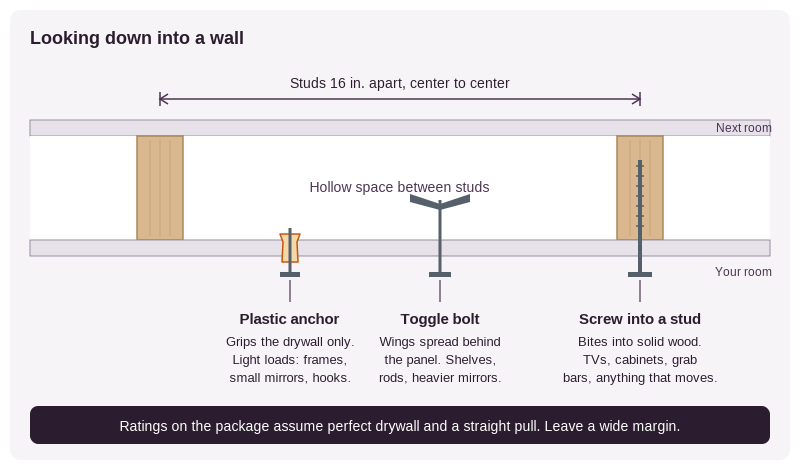
Screws into studs are the strongest option for drywall walls. A long wood screw or lag screw through the drywall and well into the stud holds heavy weight securely.
Plastic expansion anchors expand in the drilled hole. They are fine for light frames, small mirrors and towel hooks, but not much more.
Self-drilling threaded anchors screw straight into drywall and hold more than plastic anchors. Good for medium-weight shelves and decor.
Molly bolts expand behind the drywall as they are tightened. They are stronger, and the bolt can be removed and replaced.
Toggle bolts, including modern strap toggles, open behind the panel and spread the load across a wide area. They are the strongest anchors for hollow drywall.
The rated load on an anchor package assumes good drywall, correct installation and a steady downward pull. Real conditions are rarely ideal, so heavy or valuable items get a generous margin or go into studs.
What should always go into studs or blocking
- TV mounts
- Heavy mirrors and large framed art
- Floating shelves that will carry books or dishes
- Wall cabinets and heavy storage
- Grab bars, which must hold a person’s weight. The ADA standards for public buildings call for grab bars to resist 250 pounds of force, a sensible target at home too.
- Tip-over straps for dressers and bookcases
When the stud is not where the item needs to go, a wood cleat or ledger board spanning two studs gives a solid mounting surface anywhere along it. French cleats are a neat way to hang heavy mirrors and art this way.
Curtain rods and blinds
Curtain rods carry more weight than they appear to, especially with blackout drapes and children tugging on them. Brackets fastened into the framing above a window, where there is usually a solid header, hold best. Where a bracket lands on hollow drywall, a toggle or a threaded anchor rated for the load is used, and a center support bracket keeps a long rod from sagging in the middle.
Ceilings
Anything hanging from a ceiling should be fastened into a ceiling joist, never just the drywall. Plant hooks, hanging chairs and swings need a joist and hardware rated for the load, and with swings or anything people sit in, a large safety margin.
Plaster walls
Older houses, especially in Raleigh, often have plaster over wood lath. Plaster is hard and brittle, so holes are drilled rather than nailed, with tape over the spot to limit chipping. Light items can be screwed into the lath; heavy items go into studs. Toggle bolts work in plaster too.
Brick, stone and tile
Brick and stone need a hammer drill and masonry bit. Sleeve anchors, wedge anchors or masonry screws hold heavy loads. Drilling into mortar joints is easier to patch later, but solid brick holds better for heavy mounts.
Tile is drilled with a carbide or diamond bit at low speed. A piece of tape helps keep the bit from wandering, and drilling through grout joints is easier when possible.
What to avoid hitting
Electrical cables and pipes run inside walls. Avoid drilling directly above or below outlets and switches, near sinks and toilets, and behind kitchen appliances. A stud finder with AC detection can help, but it is not foolproof, so keep holes shallow where possible.
Taking things down later
Toggle bolts can be pushed into the wall cavity rather than pulled out, which keeps the hole small. Plastic anchors can be pushed in slightly and filled over. Holes left by anchors and mounts are filled, sanded and painted. See drywall repair for patching and picture and shelf hanging for having it done.
Renters
Leases often say how many holes are acceptable and what size. Checking before hanging anything heavy, and patching neatly before move-out, protects the security deposit.
When to call
If the item is heavy, valuable or overhead, or if the wall is masonry, tile or plaster, having it hung professionally is worth the cost. See TV mounting and the handyman cost guide for typical pricing.
Hanging heavy things on drywall — common questions
How much weight can drywall hold without a stud?
It depends on the anchor. A nail alone holds only light frames. Plastic expansion anchors suit light items, threaded drywall anchors hold more, and toggle bolts hold the most. The rating on the package is the limit under ideal conditions, so stay well under it.
How far apart are wall studs?
Usually 16 inches from the center of one to the center of the next, and sometimes 24 inches in newer construction. Studs also sit at both sides of windows and doors, and at corners.
Can a TV be mounted on drywall with anchors?
It should not be. TV mounts should go into studs, or into masonry with the right anchors. TVs are heavy, they are often pulled and tilted, and a falling TV can seriously injure someone.
More handyman guides
Have a list ready?
Call with the jobs on your list, or send them through the form and a local pro will come back with a price.