Loose stair railing or banister
A handrail that moves when you lean on it is not doing its job. Railings loosen at the newel post, at the joints and at wall brackets screwed only into drywall, and each one can be tightened or reinforced so it holds.
What you may notice
- The newel post at the bottom of the stairs rocks
- The handrail shifts or creaks when leaned on
- Balusters that rattle, twist or have come loose
- Wall-mounted handrail brackets pulling out
- Gaps opening where the rail meets the post
Tell us what needs fixing
Licensed trades where the law says so
Fans, fixtures and new plumbing go to licensed electricians and plumbers, as North Carolina requires. Everything else goes to an experienced handyman.
The price before the work
An hourly rate and minimum, or a flat price per job, plus what materials will cost, agreed before anyone picks up a tool.
Left cleaner than it was found
Drop cloths down, drywall dust contained, packaging and old parts hauled off, and the list walked through together at the end.
Why a solid rail matters
Stairs are where many serious falls at home happen, and a handrail is what people grab when they slip. A rail that gives way at that moment can make a fall worse. Fixing a loose rail is a small job with a large safety payoff, especially in homes with young children, older adults or visitors who do not know the stairs.
Where the wobble comes from
The newel post. The large post at the bottom of the stairs anchors the whole railing. It is often fastened only to the bottom step or the floor with a few nails or screws. Years of people swinging around it at the bottom of the stairs loosen it.
The rail-to-post joint. The handrail is usually joined to the newel with a hidden bolt or a few screws. When that loosens, the rail moves even if the post is solid.
Balusters. The vertical spindles are glued or nailed into the rail and treads. As the glue fails, they rattle and twist. Loose balusters weaken the whole rail.
Wall-mounted handrail brackets. Rails along a wall hang on brackets. If the screws went into drywall instead of studs, they pull out over time.
How each is fixed
- Newel posts are secured with a dedicated newel fastener, a long structural bolt or screw that reaches into the framing below the floor or the stair, or with blocking added beneath.
- Rail joints are tightened through an access hole under the rail, or reinforced with new hidden fasteners and glue.
- Balusters are reglued and pinned with small finish nails at top and bottom; broken ones are replaced to match.
- Wall brackets are moved to studs, or blocking is added behind the drywall, and the rail is rehung with screws long enough to hold.
Exterior and deck stairs
Outdoor stair railings face weather that indoor ones never see. Posts rot at the base, nails back out as the wood dries and swells, and fasteners rust. Through-bolting posts to the stair stringers or rim, replacing rotted posts, and switching nails for structural screws makes them solid. See deck repair.
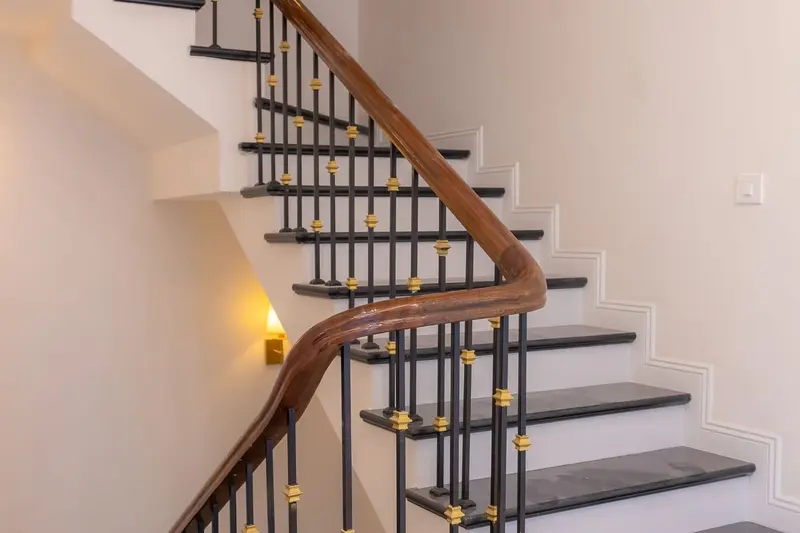
Iron balusters
Wrought iron and steel balusters are fastened differently from wood ones. They usually sit in holes drilled into the treads and the underside of the rail, held by set screws or epoxy, with a small decorative shoe covering each joint. A rattling iron baluster typically needs its set screw tightened, or its hole cleaned out and refilled with epoxy so it sits firm again.
Height and gaps
Handrails are generally set 34 to 38 inches above the stair nosing, and a rail should be easy to grip all the way around. Balusters spaced wide enough for a child’s head to fit through, or a railing that stops short of the bottom step, are worth correcting at the same time. Railings on open sides of stairs and landings also serve as guards and must be strong enough to keep people from falling over them.
Adding a second rail
For older adults and anyone recovering from surgery, a handrail on both sides of the stairs makes a real difference. Adding a wall rail is a straightforward job when it is fastened into studs or blocking, with returns at the ends so sleeves and bags do not catch.
Older homes
Older houses often have beautiful railings with complex joints that have loosened over decades. Repairs aim to keep the original railing, reinforcing it from below and inside the joints rather than replacing it. Where pieces are missing, matching balusters can sometimes be found or turned to match.
Getting it fixed
Railing repairs are usually a short visit. See trim and finish carpentry for interior stairs and railings.
Loose stair railing — common questions
What is the right height for a stair handrail?
Residential codes generally call for handrails 34 to 38 inches above the front edge of the treads, measured straight up. Older houses may not meet that, but a sturdy handrail at a comfortable height matters more than an exact number.
Do I need a handrail on both sides of the stairs?
Residential codes generally require a handrail on at least one side of stairs with four or more risers. A second rail is a common and worthwhile addition for older adults, children and anyone carrying things.
Can a loose newel post be fixed without replacing it?
Usually. Newel posts loosen because their fasteners have worked loose or were never strong enough. Newel post fastener kits and structural screws into the framing below secure most posts without removing them.
Other common repairs
Not sure what it needs?
Call and describe what is happening, or send the details through the form and a local pro will get back to you.