TV mounting in Cary, NC
A TV on the wall should be level, at a comfortable height and bolted into the framing, with the cords out of sight in a way the electrical code allows. Most mounts take an hour or two; fireplaces and brick take longer.
- Fixed, tilting and full-motion mounts
- Lag bolts into studs, not just drywall
- Over fireplaces, brick and stone
- Cords hidden in raceways or listed in-wall kits
- Soundbars and streaming boxes mounted too
Covering Cary · Apex · Holly Springs · Morrisville · Raleigh
Get a quote for TV mounting
Licensed trades where the law says so
Fans, fixtures and new plumbing go to licensed electricians and plumbers, as North Carolina requires. Everything else goes to an experienced handyman.
The price before the work
An hourly rate and minimum, or a flat price per job, plus what materials will cost, agreed before anyone picks up a tool.
Left cleaner than it was found
Drop cloths down, drywall dust contained, packaging and old parts hauled off, and the list walked through together at the end.
Why choose us
Small jobs, done right the first time
Most calls are a list of small things that have waited for months: a door that rubs, a mirror that never got hung, a hole behind a door, a toilet that runs at night. Doing each one properly, and as many as possible in one visit, is the whole job.
- Mounts anchored into studs
- Patches blended and painted
- Licensed trades when required
- Upfront hourly or flat pricing
- Whole lists in one visit
- Local to Cary
Studs first
Most interior walls in Triangle houses are wood studs behind half-inch drywall, usually spaced 16 inches apart and sometimes 24. A TV mount belongs in those studs. Drywall alone crumbles around a fastener under steady weight, and a full-motion arm multiplies the pull every time the screen swings out. Most wall plates are made to span two studs, which spreads the load and keeps the mount from twisting.
Studs are found with a stud finder, then confirmed with a tiny test hole hidden where the wall plate will cover it. Some condos and newer townhomes have metal studs instead of wood, which take different hardware, and that is worth knowing before the visit.
Picking the mount
- Fixed mounts hold the TV flat against the wall. They are the slimmest and least expensive, and they suit screens at eye level.
- Tilting mounts angle the screen down a few degrees, which helps when the TV sits higher and cuts glare from windows.
- Full-motion mounts pull out and swivel, which is useful in corners and open floor plans. They put the most leverage on the wall, so solid stud fastening matters most here.
- Pull-down mounts lower a TV from over a fireplace to viewing height when you want it.
Check two numbers before buying: the mounting hole pattern on the back of the TV, often called the VESA pattern, and the mount’s weight rating, which should comfortably exceed the TV’s weight.
Height and viewing angle
Mounting too high is the most common regret. A screen centered at seated eye level is the easy target in a family room. If the TV must go higher, a tilting mount points the picture back toward the sofa. Before any holes go in, a cardboard cutout the size of the screen taped to the wall shows exactly how a height will feel from the couch.
Over the fireplace
Many Triangle family rooms built from the 1990s on have a gas fireplace with a mantel, and the wall above it is the obvious spot. Three things need checking:
- Height. Above a mantel, the screen is usually higher than ideal, so a tilt or pull-down mount earns its price.
- Heat. Follow the TV maker’s guidance and the fireplace’s clearance instructions. A mantel helps deflect warm air. Running the fireplace for an hour and feeling the wall where the TV will go is a simple test.
- What is behind the wall. Factory-built fireplaces have a metal flue running up inside a framed chase. Mounting into that framing has to keep fasteners and the TV clear of the flue and its required clearances.
Brick, stone and tile
Masonry is strong enough for any TV, but it needs a hammer drill and masonry anchors set in solid brick or stone. Holes in brick are permanent, so the position gets measured twice. Stacked stone with deep joints may need a mount with adjustable arms to sit flat, and tile needs a diamond bit to avoid cracking.
Hiding the cords
- Cord covers. A slim paintable raceway on the wall is the simplest and works on any wall, including brick.
- In-wall kits. Listed in-wall power kits connect a recessed inlet behind the TV to an outlet lower on the wall without new wiring. They are designed for exactly this job.
- A new outlet behind the TV. That is electrical work, and in North Carolina it goes to a licensed electrician.
- Low-voltage cables. HDMI, network and speaker cables can run inside the wall through low-voltage brackets and plates.
The one thing that should never happen is a TV’s ordinary power cord stuffed into the wall cavity; the electrical code prohibits it because the cord is not built for that.
Soundbars, boxes and consoles
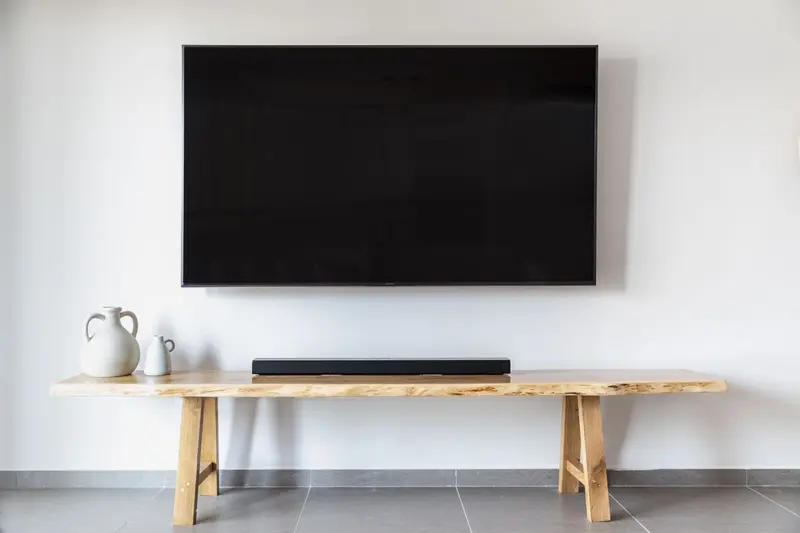
Soundbars can hang from a bracket on the TV mount or on the wall just below the screen. Streaming boxes and game consoles can sit on a small floating shelf, or tuck behind the TV on an adhesive bracket. Planning these at the same time as the TV avoids extra holes later. See picture and shelf hanging.
Before the visit
Have the TV and mount on site and unboxed if possible, decide on the height with the cardboard trick, and clear the wall and the floor in front of it. Larger TVs take two people to lift onto the mount safely.
What TV mounting costs
National cost guides put professional TV mounting at roughly $150 to $350 for a typical job. Masonry, high walls, full-motion mounts and cord concealment add to that. When a TV comes down in a move, the lag bolt holes are an easy drywall repair. The handyman cost guide has more prices.
TV mounting — common questions
How high should a TV be mounted?
For a room where people sit, the middle of the screen at about seated eye level, roughly 40 to 45 inches off the floor, is comfortable for most people. Bedrooms and rooms watched standing can go higher. A tilting or pull-down mount helps when the only spot is high, such as over a fireplace.
Can the TV power cord run inside the wall?
Not an ordinary power cord; the electrical code does not allow it. The options are a paintable cord cover on the wall, a listed in-wall power kit made for the purpose, or a new outlet behind the TV installed by a licensed electrician. HDMI and other low-voltage cables can be routed inside the wall.
What if the studs are not where I want the TV?
Many mounts have a wide wall plate or slide sideways on their rails, so the TV can be centered while the bolts still land in studs. Heavy-duty drywall anchors are only suitable for small, light screens on fixed mounts.
Often booked with this