Drywall repair in Cary, NC
Doorknob holes, anchor holes, dents, cracked corners, and the openings left behind after a plumber or electrician: repaired, textured to match and painted so the wall reads as one surface again.
- Nail pops, dents and anchor holes
- Doorknob and accident holes
- Corner and seam cracks retaped
- Texture matched, from smooth to knockdown
- Primed and painted to blend
Covering Cary · Apex · Holly Springs · Morrisville · Raleigh
Get a quote for drywall repair
Licensed trades where the law says so
Fans, fixtures and new plumbing go to licensed electricians and plumbers, as North Carolina requires. Everything else goes to an experienced handyman.
The price before the work
An hourly rate and minimum, or a flat price per job, plus what materials will cost, agreed before anyone picks up a tool.
Left cleaner than it was found
Drop cloths down, drywall dust contained, packaging and old parts hauled off, and the list walked through together at the end.
Why choose us
Small jobs, done right the first time
Most calls are a list of small things that have waited for months: a door that rubs, a mirror that never got hung, a hole behind a door, a toilet that runs at night. Doing each one properly, and as many as possible in one visit, is the whole job.
- Mounts anchored into studs
- Patches blended and painted
- Licensed trades when required
- Upfront hourly or flat pricing
- Whole lists in one visit
- Local to Cary
Matching the repair to the hole
The size of the damage decides the method:
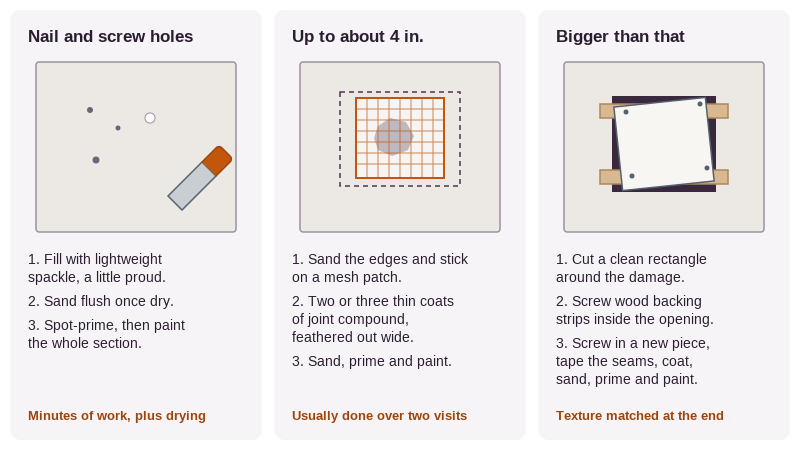
- Nail holes, screw holes and small dents are filled with lightweight spackle, sanded and painted.
- Holes up to about the size of a fist, such as the classic doorknob hole, get a self-adhesive mesh patch and two or three thin coats of joint compound feathered out well past the edges.
- Bigger holes are cut back to a clean rectangle, backed with wood strips or opened to the nearest studs, and filled with a new piece of drywall that is screwed in, taped and coated.
A doorknob hole is usually a sign the door needs a stop; adding one at the same visit keeps the patch from coming right back. See door repair.
Nail pops and screw pops
Newer houses often develop small round bumps where drywall fasteners have worked loose as the framing lumber dries. Covering them with compound alone does not last. The fix is to drive a new screw just above and below the pop to pull the panel tight against the stud, set or remove the old fastener, then fill, sand and paint.
Cracks at corners and seams
Cracks that run from the corners of doors and windows, or along a taped seam, open as a house moves slightly with the seasons. Filling them with caulk or compound alone usually fails within a year. The lasting repair is to open the crack, bridge it with mesh or paper tape, coat it in thin layers and feather it out wide. Cracks that keep returning wider, or that come with doors that stick and floors that slope, are worth having a foundation professional look at before the wall is patched again.
Matching texture
Many newer Triangle houses have smooth walls, while plenty of houses from the 1970s through the 1990s have orange-peel or knockdown texture on the walls and a sprayed texture on the ceilings. A patch that is smooth in a textured wall stands out from across the room, so the texture is recreated with a spray can, a hopper or a brush and knife before priming. Popcorn ceilings applied before the 1980s can contain asbestos, so those should be tested before anyone sands or scrapes them.
Water-damaged drywall
Stained, soft or sagging drywall from a leak has to be dealt with in the right order: the leak fixed first, the wet material cut out, the cavity dried out, and only then new drywall installed. Patching over damp drywall traps moisture. If the damage is widespread or there is visible mold behind the wall, it is a bigger job than a patch.
Painting the repair
Every patch gets primer before paint, because bare compound soaks up paint and leaves a dull spot called flashing. Painting stops at corners or natural breaks rather than in the middle of a wall, so any small difference in color or sheen is not noticeable. If the original paint cannot be found, a sample can be color-matched at a paint store.
After a move
Moving out leaves a familiar set of holes: picture nails, TV mount lag bolts, shelf anchors and furniture straps. Filling them before the final walkthrough is a common move-out job, and for renters it can protect the security deposit. See home repair punch lists.
What drywall repair costs
Small patches are often covered by a handyman’s minimum charge, especially when several are done in one visit. Larger repairs that need new drywall, texture matching and several coats cost more, and national cost guides put bigger repair jobs at a few hundred dollars. The handyman cost guide has typical prices, and the hole in drywall page explains what to do before anyone arrives.
Drywall repair — common questions
Why does a patch show through the paint?
Usually because the patch was not primed, the texture does not match, or only the patch itself was painted. Joint compound absorbs paint differently from the painted wall around it, so primer and painting the whole section corner to corner make a repair disappear.
How long does drywall repair take?
Small holes can be filled and painted in one visit using quick-setting compound. Larger patches need several coats with drying time between them, so they usually take two short visits a day or so apart.
Do I need the original paint?
It helps a great deal. Check the garage or the builder's paint list for the brand and color name, or bring a chip. Paint that has been on the wall for years may still differ slightly, which is why repairs are painted out to the nearest corner.
Problems this fixes
Often booked with this